In the fields of industrial automation and power control, power relay play an extremely important role. They allow low-power signals to control high-power loads, achieving safe isolation and automated control between devices. For many factories and enterprises, understanding the core role of power relays and how auxiliary components can enhance their performance is key to improving system stability and efficiency.
Today, we will dive into the main functions of relays in automatic control systems, showing how they help realize automation and protect equipment safety. We will also introduce how auxiliary components further enhance the overall performance of power relays. Curious about how to “empower” your relays and achieve more efficient control? Let’s explore this together.
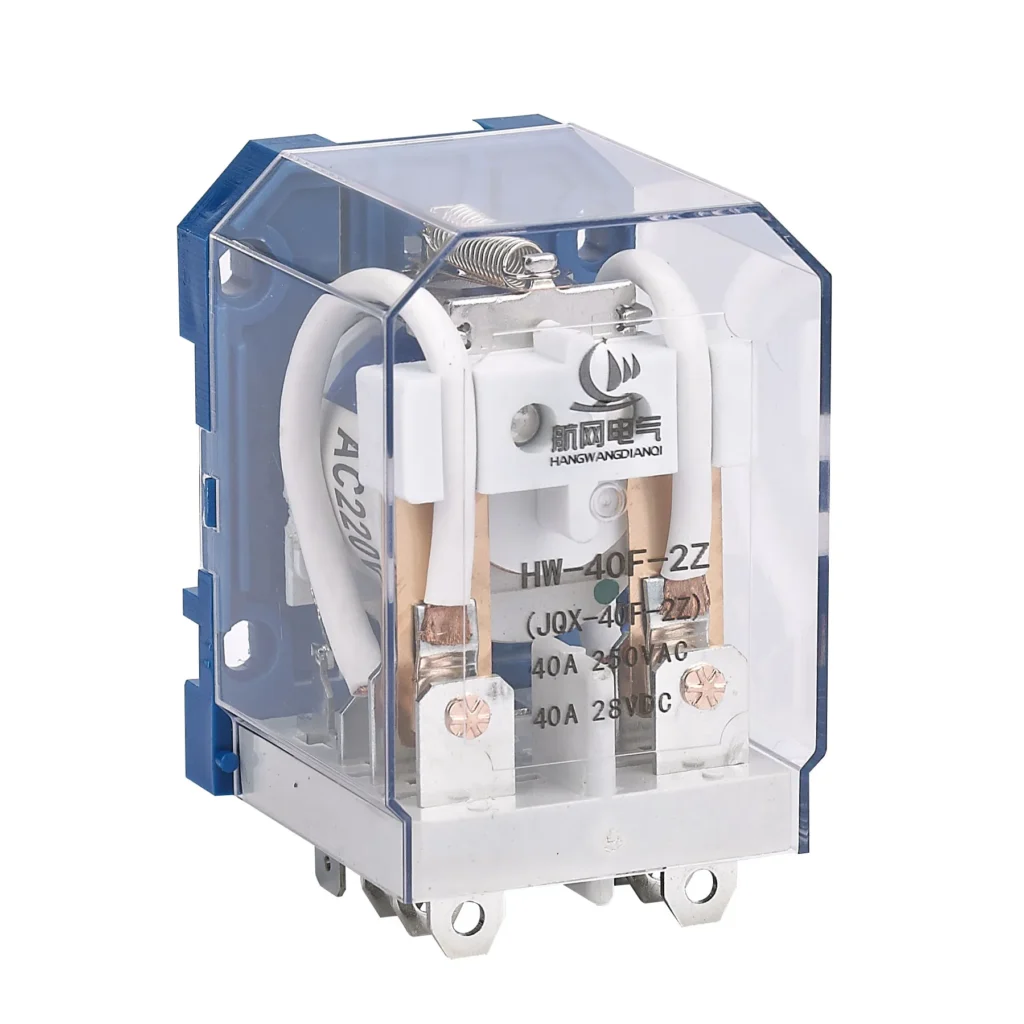
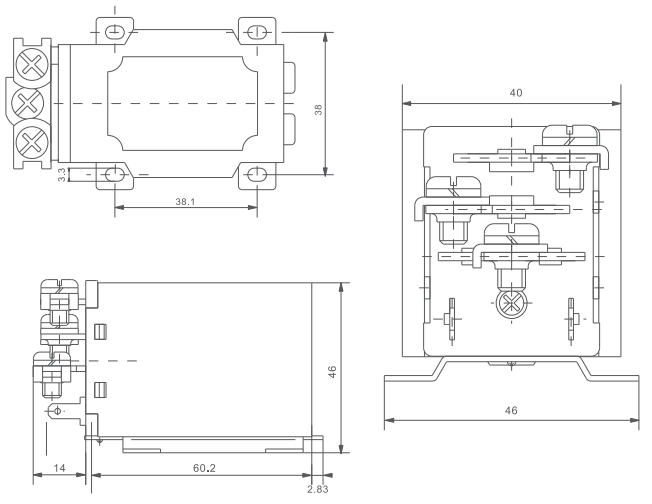
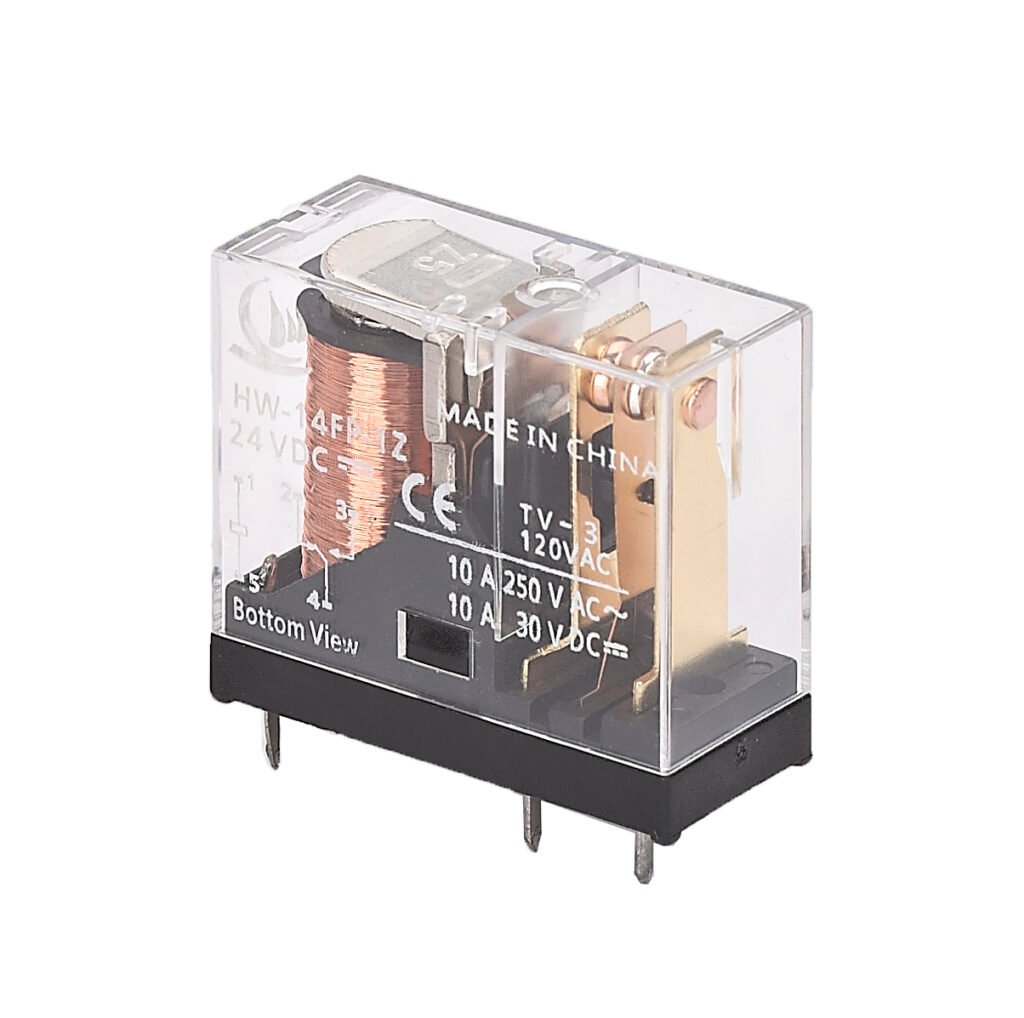
HW-40F-2Z Power Relay 40A, Dual Contacts, Rail Mount
The Core Role of Power Relays in Automatic Control Systems
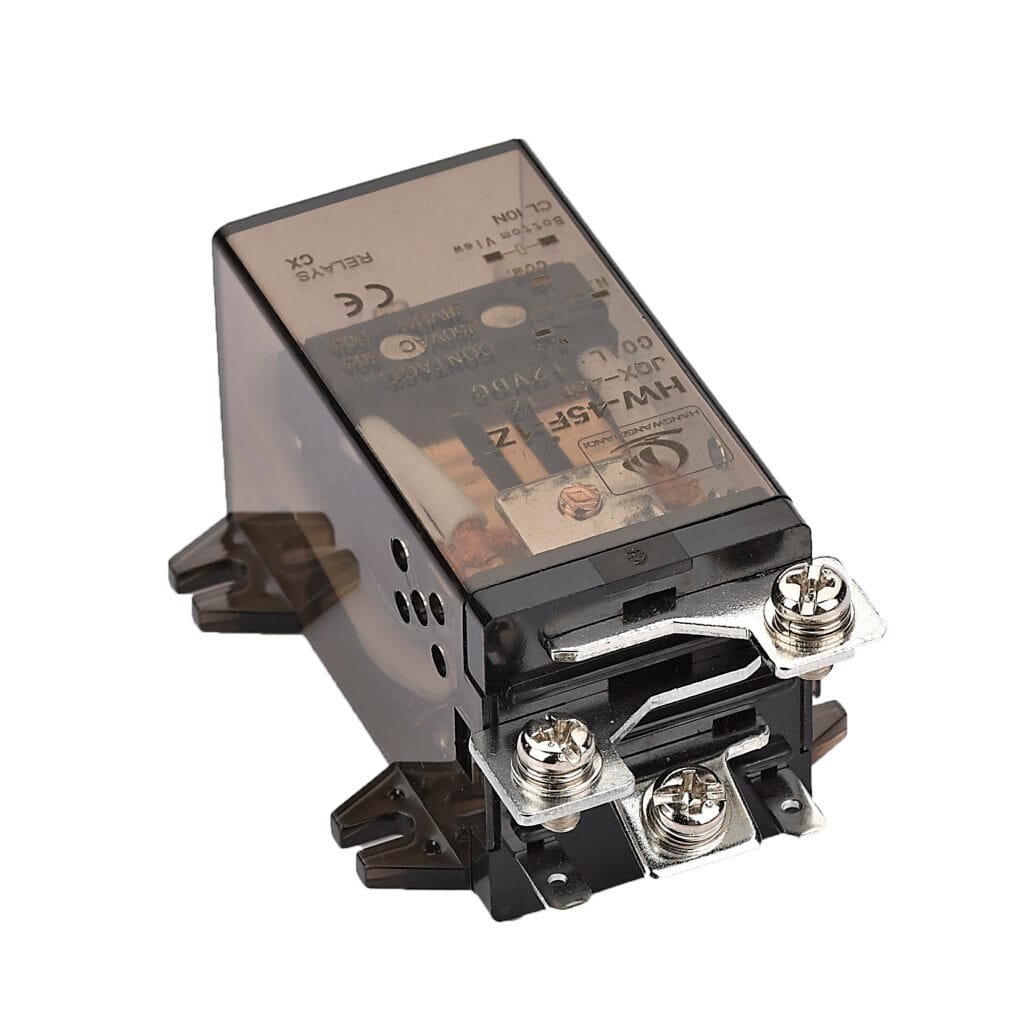
Power relays HW-40F-2Z play an indispensable role in industrial automation. They enable low-current control signals to easily manage high-power loads, ensuring automated and efficient production processes. For many automation control panels, the relay switch module is a key component, providing stable and reliable load switching.
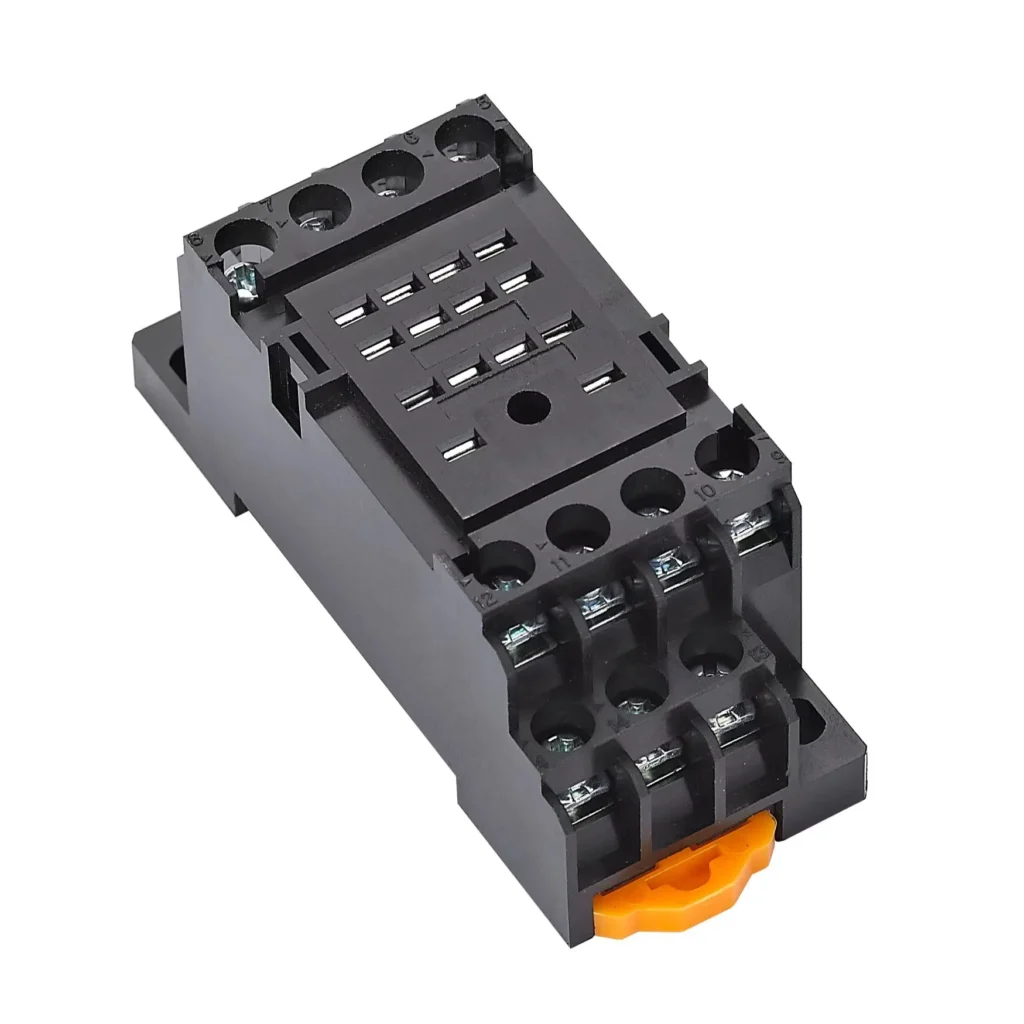
Proper design of power relay control panel wiring is crucial, as it directly impacts system maintenance convenience and operational safety. Electrical engineers reduce failure rates and enhance overall system performance by carefully selecting and arranging wiring.
When equipment malfunctions, knowing how to perform power relay troubleshooting is vital. A deep understanding of common faults and solutions for relay contacts, coils, and other parts can significantly shorten repair time and ensure quick recovery.
Power relays serve as a vital bridge connecting the control layer and execution layer of an automatic control system. They use low-current signals to drive and switch high-current circuits, achieving safe and reliable switching and control. Their key roles include:
Electrical Isolation and Signal Conversion
Power relays electrically isolate input control signals from output load circuits, preventing high voltage or current interference in control circuits.
For example, in complex industrial machinery, the control board sends low-voltage signals to relays to start or stop high-power motors.
Signal Amplification and Control of High-Power Devices
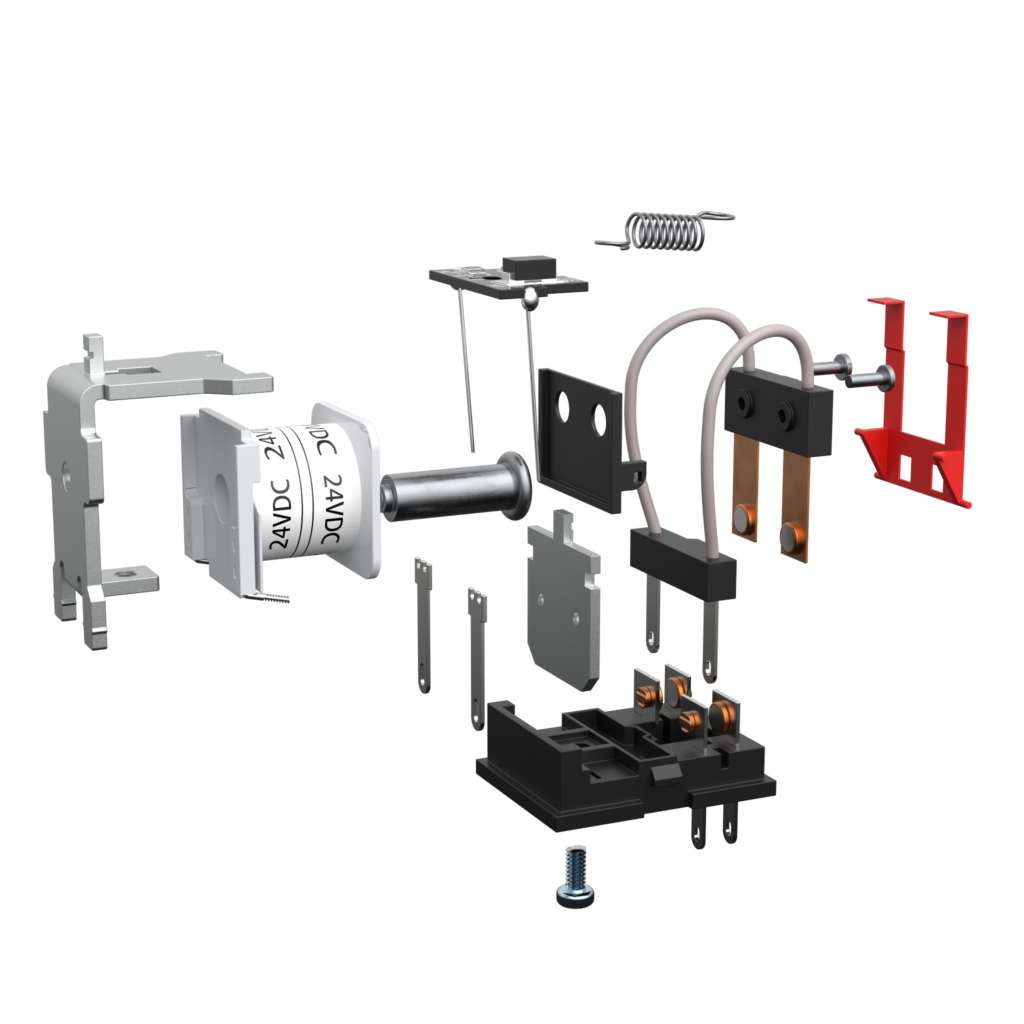
The electromagnetic mechanism inside relays uses weak control current to drive high-current switches, managing motors, heaters, fans, and other devices. Table 1 shows typical applications of power relays controlling different devices:
Control Signal Current
Type of Controlled Load
Typical Application Area
Milliampere level
Motor start, pump control
Industrial automation, assembly lines
Tens of milliamps
Lighting system switching
Smart buildings, production workshops
Hundreds of milliamps
Heating elements, solenoid valves
Power systems, HVAC
Implementing Automation Processes and Logic Control By configuring multiple relays, complex control logic such as sequential startup, interlock protection, and emergency shutdown can be achieved. Automatic control systems rely on relays for reliable switch programming to ensure safe and orderly production lines.
Protecting Equipment and Enhancing Safety Relay, combined with overload protection relays and circuit breakers, form equipment protection systems to prevent accidental short circuits or overload damage. Users can safely operate equipment under high load for extended times with confidence.
Status Monitoring and Alarms Some relay come with status indication and feedback contacts, which can monitor on/off states and integrate with remote monitoring systems for automatic alarms and maintenance reminders.
Typical Applications Across Multiple Fields
Industrial automation systems
Elevator control systems
Smart home electrical control
Energy management and distribution
UPS (Uninterruptible Power Supply) control
Contact us for custom high-performancepower relay solutions tailored to your needs.
How Auxiliary Components Enhance Power Relay Performance
Many customers ask, “How do I select the right relay for an automation system?” This is the question of how to select power relay for automation. The right relay must meet current, voltage, and contact requirements, while also considering auxiliary components to ensure high-efficiency and precise system operation.
Additionally, users often confuse auxiliary relay vs power relay. Simply put, relays handle main load switching, while auxiliary relays extend contacts and isolate signals. Both work together to achieve optimal control.
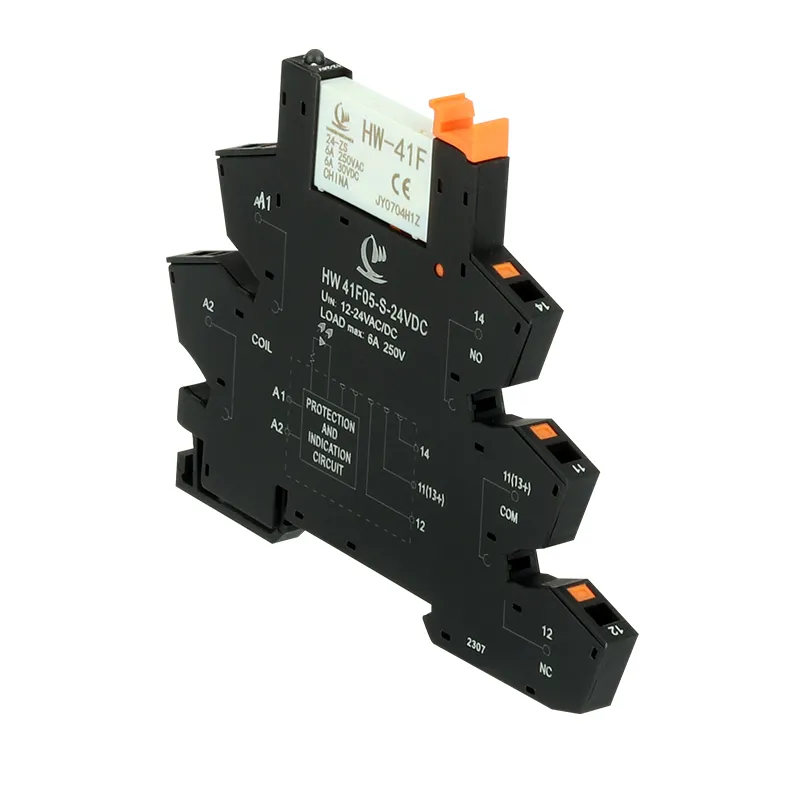
Auxiliary Relays Auxiliary relays are usually used to expand the number of contacts of the main relay or to amplify and isolate signals. They help achieve more complex control via relay cascading, enabling flexible control signal allocation.
Key Functions:
Increase the number of control circuit contacts
Improve signal stability and avoid false triggering
Enhance system interference resistance
Main Advantages
Description
Increased Control Flexibility
Enables complex logic and multi-channel control
Enhanced System Reliability
Reduces control load complexity on the main relay
Easier Maintenance
Facilitates troubleshooting and relay replacement
Functional Auxiliary Modules
Time Delay Relays: Provide delayed switching to protect equipment from frequent startups.
Surge Protectors: Guard relay coils against voltage spikes.
Remote Monitoring Modules: Provide real-time relay status feedback for intelligent maintenance and remote management.
Collaborative Protection and Intelligent Integration Auxiliary components enable power relays to work with circuit breakers, PLCs, and other intelligent devices, optimizing system response speed and protection. For example, auxiliary relays can quickly disconnect circuits during abnormalities, reducing losses.
Extended Life and Cost Savings Proper auxiliary component configuration reduces load on main relays, extending coil and contact life, lengthening maintenance intervals, and lowering long-term costs.
Famous Brand Auxiliary Relay Cases
Siemens auxiliary relays: high reliability suited for industrial automation
ABB auxiliary relays: integrate smart protection technologies, improving system stability
GE Grid Solutions auxiliary relays: optimized for grid protection
Relays are irreplaceable core components in automatic control systems. They ensure electrical isolation and power signal management while providing the foundation for sophisticated automation. Combined with auxiliary relays and components, systems become more stable, functionalities increase, and relay service life extends—delivering both economic and safety benefits.
As a relay manufacturer, helping customers understand that relays are not just simple switches but key elements of complete control solutions is invaluable. Demonstrating the advantages of auxiliary devices will deepen cooperation and enhance your brand’s professionalism.
FAQ
Q1: What is a power relay? How is it different from a standard relay?
A power relay is designed to control high-power circuits, with internal structures and contacts that can handle large currents. Compared to standard signal relays, power relays are suited for industrial-grade control and power protection.
Q2: What is the difference between an auxiliary relay and a power relay? Why use auxiliary relays?
Power relays control main load switches, while auxiliary relays expand contacts and isolate signals, improving the system’s execution capability and reliability for complex logic.
Q3: How do I select a suitable power relay for industrial automation?
Consider rated current, voltage, number of contacts, and response time. Also, match suitable auxiliary components and protection devices to ensure system stability and safety.
Q4: How should power relay wiring be designed in industrial control cabinets?
Wiring should follow electrical safety standards, arrange relay locations reasonably, and keep signal and load lines clearly separated for easy maintenance and troubleshooting.
Q5: How to troubleshoot a relay when it malfunctions?
Check coil power supply, contact conditions, and control signals first. Verify the auxiliary components’ function. Refer to power relay troubleshooting guides to quickly locate faults.
A Power Relay is a critical electrical device that acts as a switch, allowing a low-power circuit to control a high-power circuit safely and efficiently. Think of it as a middleman that controls heavy machinery or electrical loads without needing you to manually flip a switch every time. Power relays are extensively used in industrial […]
Relay symbols are the cornerstone of electrical engineering, the universal language for designing, troubleshooting, and maintaining electrical systems.
Relays utilize different types of Relay Contacts to control circuits based on specific conditions. The main contact types include Conversion Type, Normally-ON Type, and Normally-OFF Type. Here’s a detailed explanation of each: Description of contact forms: Type Default State Energized State Relay contact structure Conversion Type C to NC connected C switches to NO Normally-ON […]
We use cookies to enhance your browsing experience, serve personalised ads or content, and analyse our traffic. By clicking "Accept All", you consent to our use of cookies.
Get a Free Quote
Your email information is completely secure and will not be disclosed to third parties for any reason.
Interested In Our Relay Products?
Get the latest product brochures and technical data.