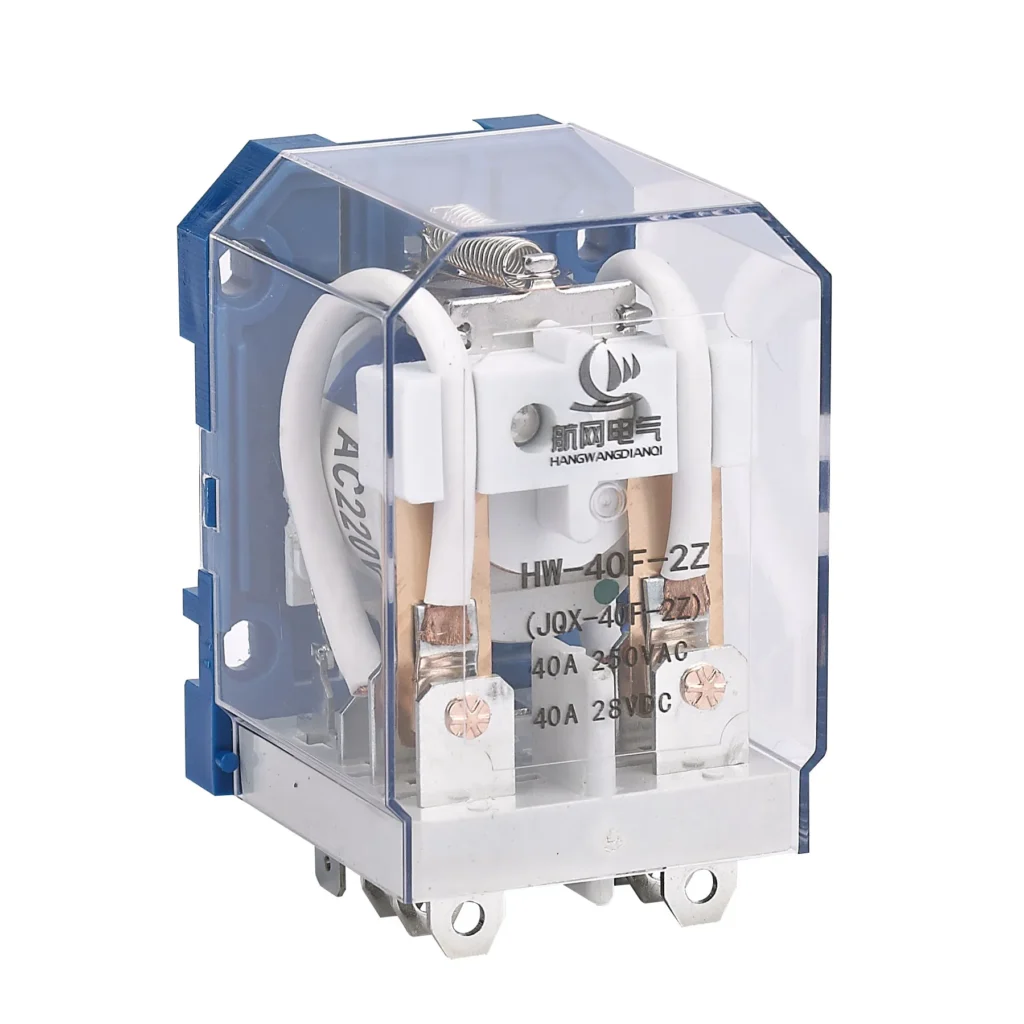
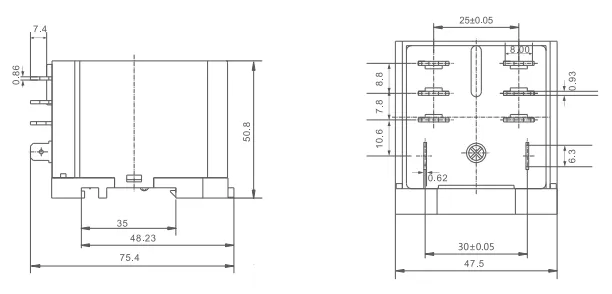
When someone types “Power Relay 40A, Dual Contacts, Rail Mount”, they not trying to write a PhD thesis. They want a relay that can survive real‑world loads, fit in a crowded control cabinet, and be easy enough for the wiring team not to swear at it. HW‑40F‑2Z sits exactly in that spot: a 40A power relay with dual contacts (DPDT‑style) and a rail‑mount base that makes it very friendly for industrial panels, HVAC control, machinery and power switching.
In this article I’ll talk through what this relay really is, how I’d wire it conceptually in a cabinet, how to select the right version, and when HW‑40F‑2Z makes sense on your BOM compared with other 40A relays or small contactors. And yes, I’ll keep it practical—if you can’t use it in a real panel, it doesn’t belong here.
What a 40A Dual Contact Rail‑Mount Relay Really Is
A “Power Relay 40A” is a high‑power electromechanical relay designed to switch up to roughly 40A of current at typical mains or DC voltages. In simple words: it’s the part you put between your delicate control electronics and your heavy‑duty loads like motors, compressors, heaters and power supplies. When you add “Dual Contacts”, you’re usually talking about a DPDT or 2‑changeover configuration—two separate contact sets that move together when the coil is energized.
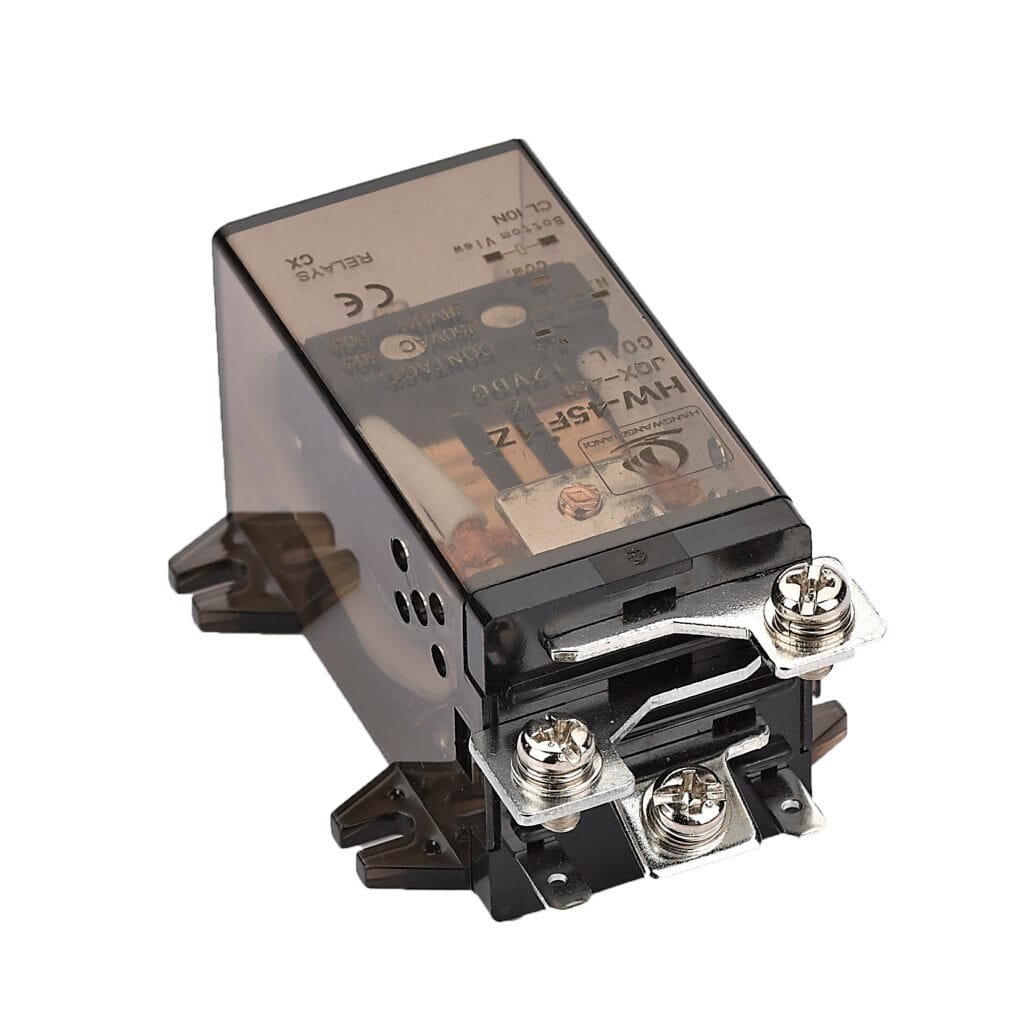
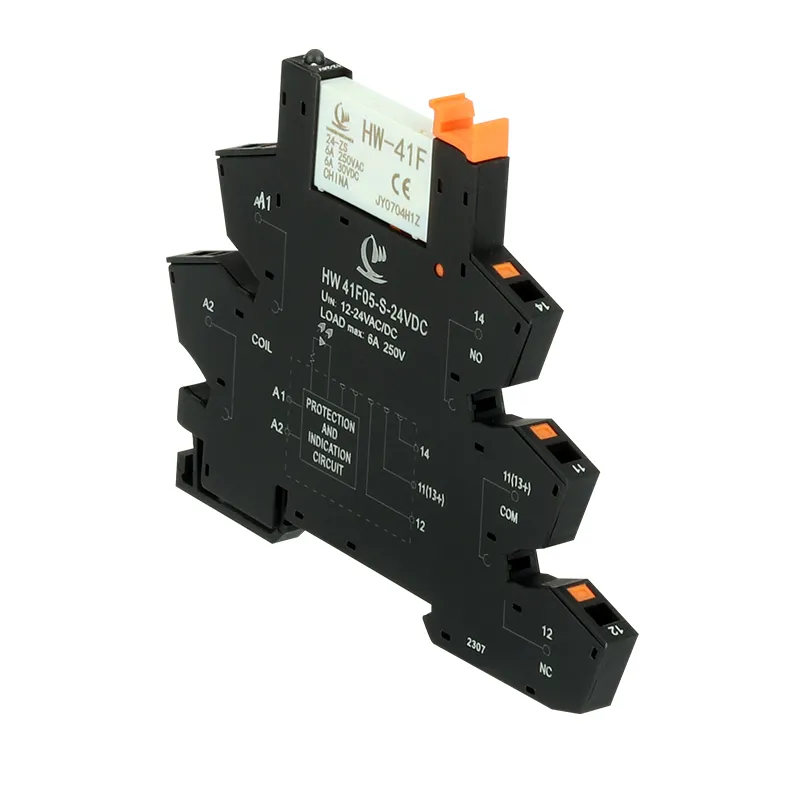
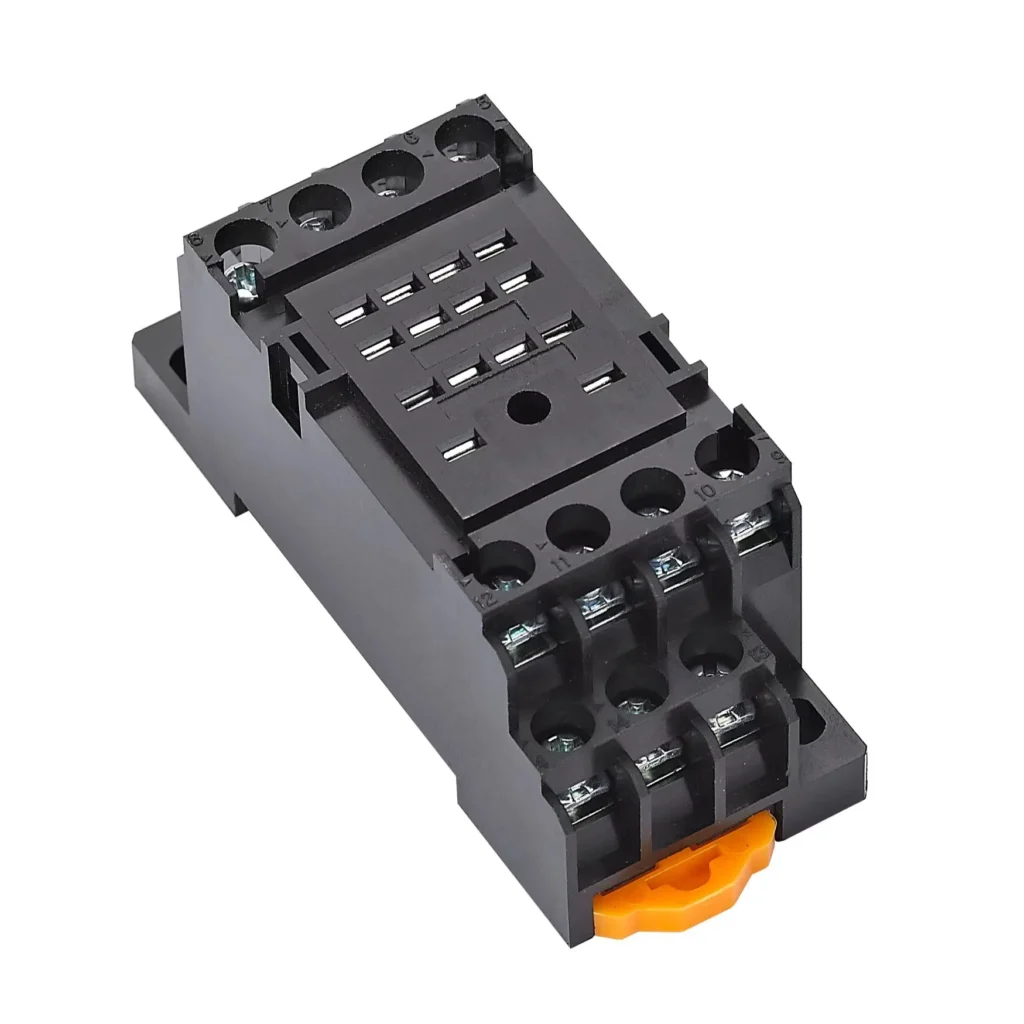
HW‑40F‑2Z belongs to this class of 40A DPDT power relays. It’s built to sit in a control panel on a rail‑mount base, so instead of soldering it to a PCB, you snap the base on the DIN rail and land cables on screw terminals. That alone already tells you the target users: panel builders, OEM machine manufacturers, HVAC system integrators, and anyone building switchboards or control boxes that see real current.
A 40A dual‑contact relay like HW‑40F‑2Z usually offers:
A 40A‑class contact rating, so it can handle high loads with some headroom.
Dual changeover contacts, so you can switch two lines, or one power line plus a feedback or interlock circuit.
A choice of AC or DC coil voltages, matching typical control voltages like 12 Vdc, 24 Vdc, 24 Vac, 110 Vac, 220 Vac.
Rail‑mount or socket‑mount format, for quick replacement and easy field wiring.
If most of your applications are in the 20–32A working range with occasional higher inrush, this type of relay is right in its comfort zone.
Let me translate “Power Relay 40A, Dual Contacts, Rail Mount” into the kind of bullet points that make engineering and purchasing both nod.
First, current and voltage. HW‑40F‑2Z is designed as a 40A class relay, which means its contacts and internal structure are sized for substantial loads. In practice, people often run it below the full 40A for thermal margin, especially with inductive loads like motors or compressors. But having that rating gives you breathing space when you’re sizing components for a demanding environment.
Second, dual contacts. With a DPDT (2‑changeover) layout, each pole has a common (COM), a normally closed (NC), and a normally open (NO) terminal. When the coil is off, COM is connected to NC; when the coil turns on, COM switches to NO. You get two of these poles in one relay, driven by one coil. That gives you a lot of flexibility:
Switch two poles of a single‑phase load through both contacts.
Use one pole for power and another for a status or interlock circuit.
Control two separate smaller loads in one relay (within rating).
Third, mounting. Rail‑mount makes HW‑40F‑2Z friendly for control cabinets. Instead of having a big, hot component soldered on a board, you snap the base on a rail and wire it like a small contactor. For panel builders, that means:
Faster installation and easier layout changes.
Simple replacement in case of failure—just pull the relay off the base.
Better separation between control PCB and power wiring.
Feature snapshot
Aspect
What HW‑40F‑2Z‑type 40A relay gives you
Contact rating
40A class, suitable for motors, compressors, heaters and PSUs
Contacts
Dual changeover (DPDT / 2Z), two separate switching circuits
Coil options
Multiple AC/DC voltages, matching common control supplies
Mounting style
Rail‑mount via socket/base, easy installation and replacement
Typical environment
Industrial panels, HVAC units, power control, machinery wiring
So when your spec sheet says “Power relay 40A DPDT rail mount” and you’re looking at HW‑40F‑2Z, you’re right on target.
How I’d Wire a 40A Dual Contact Rail‑Mount Relay
Now, the part that really matters in the field: how to connect it. I’ll stay at a conceptual level, because actual pin numbers depend on the base and your drawing. But once you understand the logic, HW‑40F‑2Z behaves like any other DPDT power relay.
You’ve basically got three sets of things to care about:
The coil terminals.
The COM‑NO‑NC for contact set 1.
The COM‑NO‑NC for contact set 2.
When the coil is not energized, COM is connected to NC on each pole; when energized, COM switches to NO. That never changes. What changes is how you use those poles.
Example: single‑phase motor or heater
In a typical single‑phase application, I’d do something like this conceptually:
Bring the phase line into COM of Pole 1 and COM of Pole 2.
Bring the phase out from NO of Pole 1 and NO of Pole 2 to the load, or to two separate loads.
Neutral often goes directly to the load (unless you’re switching both conductors for isolation).
Coil is driven by the control circuit—PLC output, thermostat, controller relay, etc.
That way, when HW‑40F‑2Z pulls in, both poles switch simultaneously. You can either share current between poles (if allowed by the relay spec and your design rules) or use one pole for each branch or phase.
Example: power plus feedback
This one is popular with control engineers:
Use Pole 1 COM and NO to switch the actual power line to the load.
Use Pole 2 as a low‑current contact for feedback, interlock or status. For example, COM goes to a PLC input, NO to a control voltage, so when the relay energizes, the PLC sees a “run” signal.
That way, one HW‑40F‑2Z gives you both power switching and a clean status contact, without a separate auxiliary relay.
Example: changeover between two sources
Another classic DPDT tactic is changeover between two feeds (like normal and backup) to one load, used only when your system design and safety rules permit it:
COM goes to the load side.
NO goes to source A.
NC goes to source B.
When the coil is off, the load uses source B; when the coil pulls in, the load switches to source A. The second pole can mirror the same logic for another conductor or be used for status.
In the panel, all of this happens on the rail‑mount base terminals. In practice, I’d always:
Respect the recommended cable size for 40A class contacts.
Use ferrules on stranded wires.
Keep coil wiring away from thick power cables for neatness and EMC reasons.
Do that, and HW‑40F‑2Z behaves like a small, well‑mannered contactor in your cabinet.
Contact us for custom Power Relay 40A HW‑40F‑2Z solutions tailored to your needs.
How to Choose the Right 40A Relay Version (and When HW‑40F‑2Z Fits)
Choosing the right “Power Relay 40A, Dual Contacts, Rail Mount” is not about memorizing all parameters; it’s about checking a few key items and ignoring the noise. Here’s how I’d walk through it when deciding whether HW‑40F‑2Z belongs on the BOM.
1. Load current and type
First question: what are you switching? A 2 kW heater, a 3 kW motor, or a big compressor?
For resistive loads (heaters, some lighting), a 40A rating often gives you comfortable margin.
For inductive loads (motors, compressors, transformers), inrush can be several times the normal current, so you size the relay with extra headroom.
If your continuous current is somewhere in the mid‑20A range and your peak current is within what a 40A relay is built to handle, HW‑40F‑2Z is a sensible choice. If you’re hitting 40A continuously with brutal inrush, I’d personally start thinking about a proper contactor.
2. Contact configuration needs
Ask yourself:
Do I need to switch one heavy line only?
Do I need two lines or two loads?
Do I need a feedback or interlock contact as well as power switching?
If you need any combination of those, a DPDT relay like HW‑40F‑2Z is ideal. You can:
Use both poles for power (for two lines or for redundancy by design).
Use one pole for power, one for feedback.
Use one relay to control two smaller loads.
If you only ever switch a single line with no need for auxiliary contacts, a single‑pole 40A relay might still work, but the dual contacts on HW‑40F‑2Z give you extra flexibility for future design tweaks.
3. Coil voltage and control system
Coil choice is where many purchasing mistakes happen. I’d always check:
What control voltage is already present in the panel—24 Vdc, 24 Vac, 110 Vac, 220 Vac?
Is the driver a PLC, a thermostat, a small control relay, or a manual switch?
Is the output type transistor, relay or triac?
Once you know that, you simply pick the HW‑40F‑2Z coil version that matches your control bus. Using a 24 Vdc coil on a 24 Vdc control bus, for example, avoids extra power supplies and keeps the wiring straightforward. If your PLC has relay outputs with 220 Vac available, then a 220 Vac coil might make more sense.
4. Mounting and maintenance strategy
If you’re building standardized panels, the rail‑mount format is a big plus:
Technicians can swap a faulty relay in minutes without touching the wiring.
Stock management gets easier—you can hold a few HW‑40F‑2Z units and compatible bases, and use them across multiple projects.
Panel layout is cleaner, because the heavy power wiring lives at the relay base, not on the PLC board.
If your design philosophy is “panels that are easy to service even at 3 a.m. in a factory”, a 40A rail‑mount relay like HW‑40F‑2Z fits that mentality.
5. Standardization vs. one‑off
Many OEMs prefer to standardize on one or two relay platforms. HW‑40F‑2Z is the kind of model you can turn into a “house standard” for:
40A‑class AC or DC loads.
Dual contact applications.
Control cabinets where rail‑mount is the default.
Once you lock that in, engineering, purchasing, and service all speak the same language, and life becomes much easier.
If you’re at this stage and thinking, “Yes, I could unify my 40A positions around this spec,” that’s usually your cue to send an inquiry for HW‑40F‑2Z with the coil voltages and annual quantity you need.
Where HW‑40F‑2Z Shines in Real Applications
Let’s look at typical scenarios where a “Power Relay 40A, Dual Contacts, Rail Mount” like HW‑40F‑2Z not only works, but is actually a neat choice.
Industrial automation panels
In automation cabinets, a standard pattern is:
PLC drives relay coil.
Relay switches power to a motor, heater, lamp bank, or actuator.
Here, HW‑40F‑2Z behaves like a compact interface between logic‑level control and high‑power loads. The dual contacts let you have one pole for power, one for feedback or interlocks. That’s especially handy when you want the PLC to know if the relay is actually energized (hardwired confirmation), or when you build safety chains and mutual interlocks.
HVAC units and chillers
HVAC is full of loads with harsh inrush:
Compressors.
Fan motors.
Electric heaters and elements.
A 40A relay with dual contacts and rail mount is a natural fit for compressor control, electric heater elements and fan switching, especially in rooftop units, chillers and packaged systems. HW‑40F‑2Z gives the HVAC control board a robust power stage without going up to full‑size contactors for medium‑power loads.
Inverters, stabilizers and UPS systems
Power electronics often need relays to:
Switch outputs between different modes.
Bypass circuits.
Connect or disconnect loads under control.
In those cases, a 40A relay like HW‑40F‑2Z can act as the mechanical switching element that complements solid‑state circuitry, especially when you need visible isolation or low leakage in the off state.
Pumps and water treatment
Pumps, blowers and agitators in water treatment or process skids often fall right into the 40A window. Using HW‑40F‑2Z in the panel gives you:
Enough current rating for typical pump motors.
Dual contacts for power and status.
A compact, rail‑mount solution that fits small pump controllers as well as larger systems.
If any of these scenarios match your product line or project pipeline, HW‑40F‑2Z is the kind of relay you want sitting in your standard components library.
If you’re currently screening options under the “Power Relay 40A, Dual Contacts, Rail Mount” category and HW‑40F‑2Z fits your current and voltage range, this is usually the moment to decide the coil voltage, confirm your annual usage, and send an inquiry for pricing or samples—before your next project schedule gets tight.
FAQ
Is a 40A relay enough for my application?
If your continuous current is below the 40A rating and your inrush current isn’t extreme beyond what a typical 40A power relay is designed for, then yes, this class is usually sufficient. For very heavy starting currents or large motors, a contactor might be more appropriate.
What does “dual contacts” or “2Z” actually mean?
“Dual contacts” refers to two separate changeover poles—each with COM, NO and NC. “2Z” is often another way of saying two changeover contacts. When the coil is energized, both poles switch at the same time.
Can I use HW‑40F‑2Z as an intermediate relay between a PLC and a big load?
Absolutely. That’s one of the most common uses. The PLC or controller drives the coil, and the relay’s contacts handle the mains or DC bus going to the load, keeping the controller safely isolated from high current and voltage.
How do I know which coil voltage to choose?
Check what control voltage you already have available. If your control system runs on 24 Vdc, choose a 24 Vdc coil version. If you have 220 Vac control power and relay outputs, choose the corresponding AC coil. Matching the coil to your control bus keeps the power supply design simple and avoids extra components.
Why choose rail mount instead of PCB mount at 40A?
At 40A, PCB‑mount solutions become more demanding in terms of copper thickness, clearance and thermal design. Rail‑mount relays let you keep the heavy current on wires and screw terminals, away from sensitive PCBs. They’re also far easier to service and replace in the field.
Can HW‑40F‑2Z replace a small contactor?
In many medium‑power applications it can. For moderate motor sizes, heaters and similar loads, a 40A power relay gives you contactor‑like performance with a smaller footprint and often a lower cost. If your specs require contactor‑type mechanical endurance or specific standards, you might still opt for a true contactor.
Can I standardize my 40A positions on HW‑40F‑2Z?
That’s actually a smart strategy. If your projects repeatedly need “Power Relay 40A, Dual Contacts, Rail Mount” with a few common coil voltages, using HW‑40F‑2Z as a platform simplifies purchasing, stock, documentation and after‑sales service.
Contact us for custom Power Relay 40A HW‑40F‑2Z solutions tailored to your needs.
In the fast-moving world of industrial automation, reverse power relay are small but crucial components that safeguard generators and parallel power systems. If you’re an engineer, electrical system designer, or purchasing manager, understanding how this device works—and how to select the right one—can help you prevent expensive downtime, hazardous faults, and unnecessary wear on your equipment. Let’s explore what makes […]
A Power Relay is a critical electrical device that acts as a switch, allowing a low-power circuit to control a high-power circuit safely and efficiently. Think of it as a middleman that controls heavy machinery or electrical loads without needing you to manually flip a switch every time. Power relays are extensively used in industrial […]
Have you ever wondered what kind of “switch” behind large and complex industrial equipment makes motors start smoothly and machines stop safely? The answer is the power relay. Although power relays seem inconspicuous, they play a critical role in ensuring industrial automation systems run smoothly and efficiently. In this article, we will take you deep […]
We use cookies to enhance your browsing experience, serve personalised ads or content, and analyse our traffic. By clicking "Accept All", you consent to our use of cookies.
Get a Free Quote
Your email information is completely secure and will not be disclosed to third parties for any reason.
Interested In Our Relay Products?
Get the latest product brochures and technical data.