Choosing the right coil voltage for a power relay switch can feel tricky, especially when you are designing industrial control panels, OEM equipment, or automation systems for demanding B2B projects. You not only need the relay to pull in reliably, you also have to think about supply tolerance, safety, heat, and long‑term reliability. This guide walks through how coil voltage works, which options are common in industrial power relay switches, and how to select the best value for your application—without over‑engineering or risking failures in the field.
If you are sourcing power relay switches in volume and want tailored coil voltage options (for example 12 VDC, 24 VDC, 110 VAC, 230 VAC), you can always send an enquiry with your load data and control voltage, and an engineer can recommend suitable SKUs quickly.
Understanding Power Relay Switch Coil Voltage
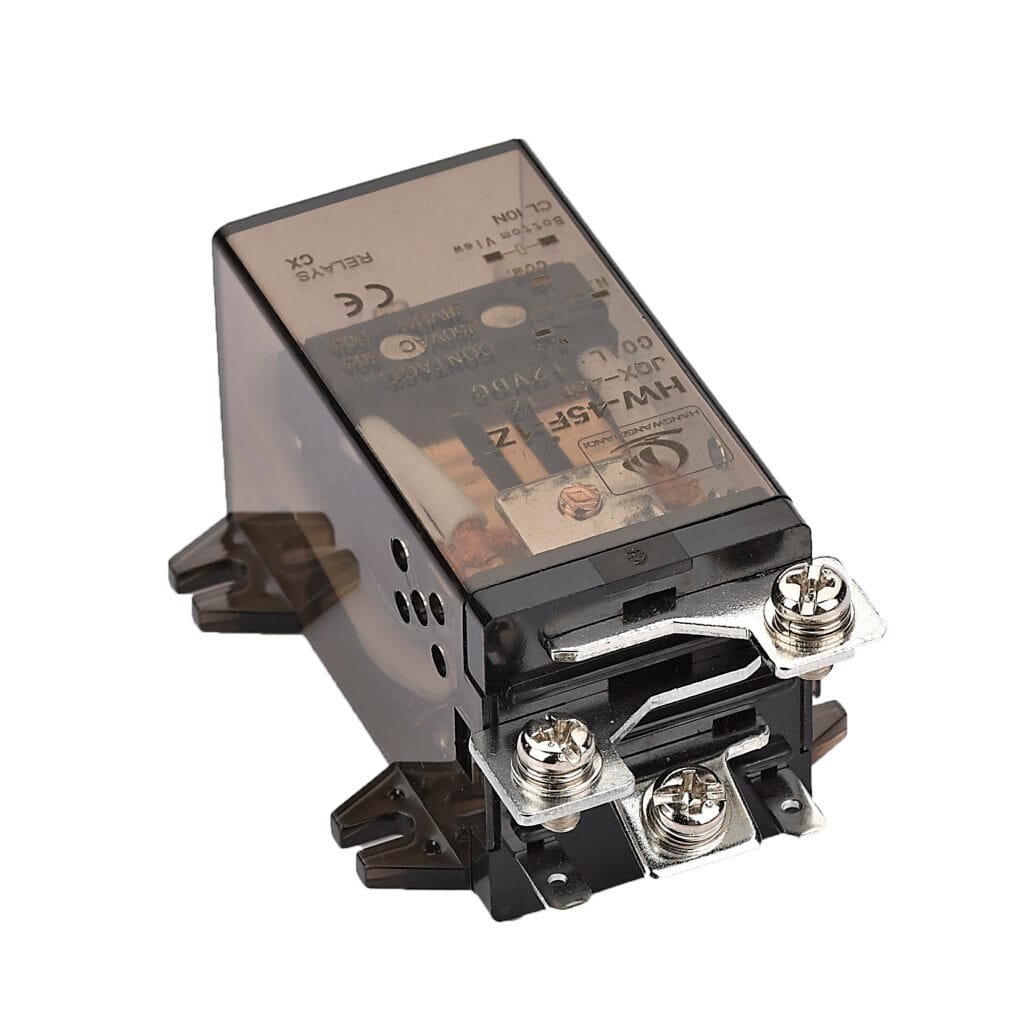
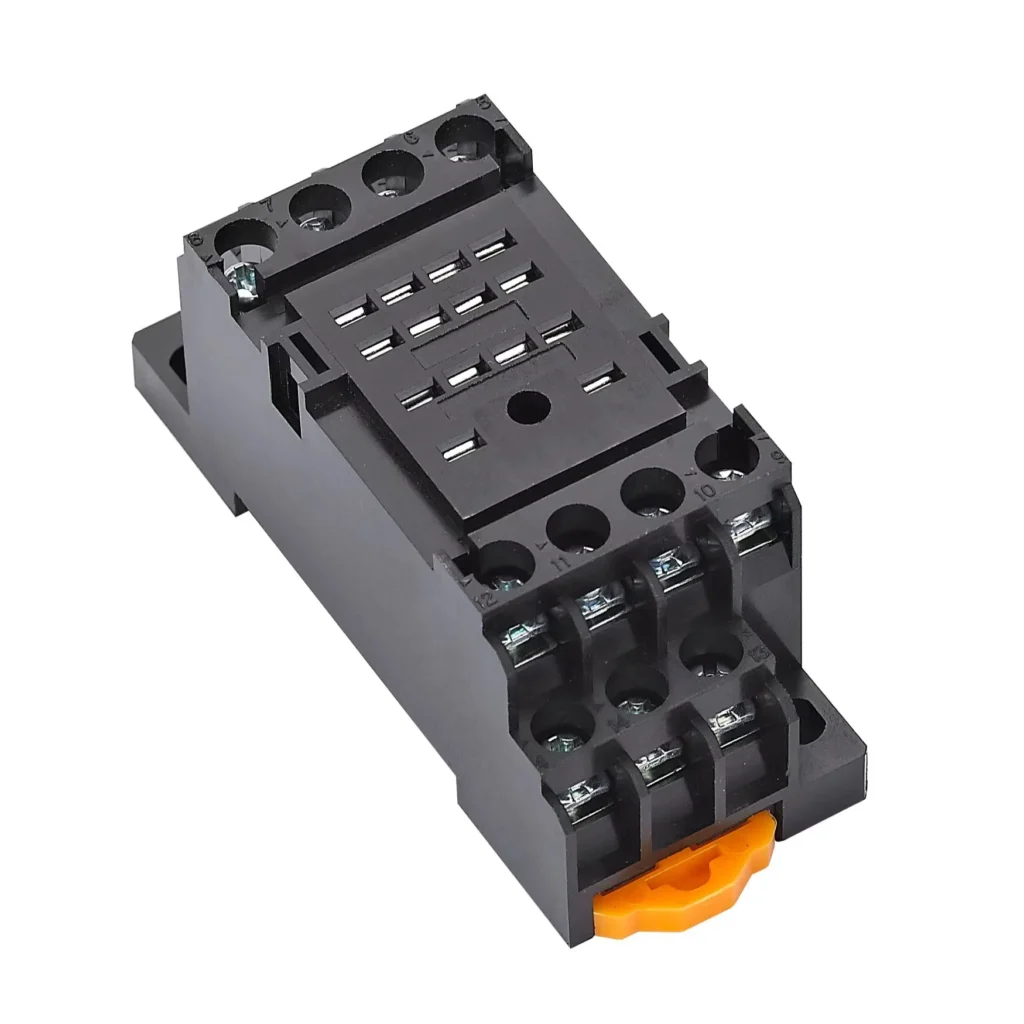
A HW-40F-2Z power relay switch has two sides: the coil side (control) and the contact side (load). Coil voltage refers to the rated voltage that must be applied to the coil to reliably energize the relay and change the contact state.
Most industrial power relay switches are available with multiple coil voltage variants—common choices include 5 VDC, 12 VDC, 24 VDC, 48 VDC, 110/120 VAC, and 220/230 VAC coils—while the contact side may be rated for much higher load voltages such as 250 VAC or more. The coil voltage rating is independent of the contact rating; you can easily have a 24 VDC coil operating a 400 VAC motor circuit through the contacts as long as the contact ratings are respected.
Datasheets typically list several important coil‑related values that B2B engineers should check carefully.
Nominal (rated) coil voltage: The voltage the relay is designed for, such as 24 VDC.
Pick‑up (turn‑on) voltage: The minimum voltage at which the relay coil is guaranteed to pull in, usually a percentage of nominal (for example 70–80%).
Drop‑out (turn‑off) voltage: The voltage below which the coil releases and the relay returns to its rest position, often much lower than the pick‑up threshold.
Maximum coil voltage: The highest voltage that can be applied continuously or for a specified time without exceeding temperature limits or damaging the coil.
These parameters define an “operating window” for reliable switching: above the pick‑up voltage the relay should energize, below the drop‑out voltage it should release, and between these values there is often a zone where behavior can be uncertain.
Table: Typical Coil Voltage Ratings And Uses
Coil type
Typical voltage options
Common use cases
Low‑voltage DC
5 V, 6 V, 9 V, 12 V
PCB relays, microcontroller boards, IoT devices, low‑power control modules.
Standard DC
24 V, 48 V
Industrial control panels, PLC outputs, machine automation, 24 VDC control power.
Low‑voltage AC
24 VAC, 48 VAC
HVAC systems, building automation, small contactors close to control transformers.
Mains AC
110/120 VAC, 220/230 VAC
Direct‑mains contactors, motor starters, legacy control circuits without DC supply.
Why Coil Voltage Choice Matters In Power Relay Switches
Choosing the wrong coil voltage for a power relay switch can cause surprisingly costly problems in B2B applications. If the coil voltage is too low for the supply, the relay may never energize; if the coil voltage is too high, the relay may appear to work but run hot, age quickly, or fail prematurely.
For OEMs and panel builders, reliability and safety are top priorities. A relay that fails to pull in under brown‑out conditions can stop an entire production line; a coil that overheats may pose a safety risk or fail regulatory testing. Long‑term stability is also critical for systems that must run 24/7 in harsh industrial environments, such as process plants, data centers, and HVAC equipment.
Impact on system design
Your coil voltage selection also affects upstream design decisions.
Power supply sizing: Lower coil voltage usually means higher coil current for the same power, which can load low‑voltage regulators more heavily.
EMI and wiring: Higher coil voltage with lower current can reduce I²R losses and voltage drop on long control cables, which is useful in large facilities.
Interface with PLCs and controllers: Many PLC digital outputs are designed for 24 VDC relay coils, so choosing those can simplify wiring and reduce the need for extra interface modules.
Table: Consequences Of Incorrect Coil Voltage
Situation
Typical symptom
Risk in B2B application
Coil voltage < pick‑up voltage
Relay never pulls in or only sporadically.
Intermittent machine start, random downtime, service calls.
Coil voltage near lower limit
Chattering contacts, unreliable switching.
Contact wear, arcing, possible overheating of load.
Coil voltage > maximum rated
Excessive coil temperature, shortened life.
Early failures, warranty claims, possible safety issues.
Using wrong AC/DC coil type
Relay may not operate or overheats.
Misoperation, damage to control supply or relay.
How To Choose The Right Coil Voltage Step By Step
So how do you actually pick a coil voltage for your power relay switch in a real project? The good news is that the process is straightforward if you follow a simple checklist.
1. Start from your control supply
First, identify the control voltage rail you already have in your system.
If your control panel uses 24 VDC for sensors, PLC, and HMI, then a 24 VDC coil power relay switch is usually the best match.
For embedded electronics with 5 V or 3.3 V logic, you might choose relays with 5 VDC or 12 VDC coils driven via transistor or driver ICs.
In HVAC or some legacy systems where a 24 VAC or 120 VAC control transformer is standard, an AC coil relay or contactor matched to that control voltage is typical.
As a general rule, select a relay coil rated for the control voltage you can provide easily and robustly, instead of introducing a new voltage rail just for the relay.
Table: Matching Coil Voltage To Control Supply
Existing control supply
Recommended coil voltage
Comment
5 VDC logic rail
5 VDC coil
Good for PCB relays; check coil current vs. driver capability.
12 VDC auxiliary supply
12 VDC coil
Common in automotive and telecom applications.
24 VDC industrial rail
24 VDC coil
Standard for PLC and industrial I/O interfaces.
24 VAC control
24 VAC coil
Typical in HVAC, building services.
110/120 VAC mains
110/120 VAC coil
For direct mains‑powered relays/contractors.
220/230 VAC mains
220/230 VAC coil
For global mains applications and motor starters.
2. Check supply tolerance and operating window
Next, consider how much your control voltage can vary in real life—under brown‑out conditions, start‑up surges, or long cable runs. Compare this range with the relay’s pick‑up and drop‑out voltage specifications.
For example, a 24 VDC coil may have a pick‑up voltage of about 70% of nominal (around 16–17 V) and a drop‑out voltage below 20–30% of nominal. In that case, as long as your 24 V supply never drops below the pick‑up threshold when the relay is supposed to energize, operation will be reliable. It is also important to make sure that any upper tolerance (for example, 28–30 V during charging) stays below the maximum continuous coil voltage in the datasheet.
Table: Example 24 VDC Coil Operating Range
Parameter
Typical value (example)
Design implication
Nominal coil voltage
24 VDC
Main design target.
Pick‑up voltage (max)
16–18 VDC (≈70–75%)
Supply must be above this for reliable pull‑in.
Drop‑out voltage (min)
2–6 VDC (≈10–25%)
Below this the relay releases.
Maximum coil voltage
30–32 VDC (or catalog value)
Supply should normally stay below this limit.
Contact us for custom high-performancepower relays Coil Voltagesolutions tailored to your needs.
3. Consider coil power, heat, and energy efficiency
Coil power is another important factor, especially for high‑density panels or equipment with tight thermal budgets. Coil power is essentially the product of coil voltage and current; higher power means more heat inside the relay and inside your enclosure.
Often, higher voltage coils draw less current for the same sensitivity, which reduces the load on driver ICs and wiring resistance losses. However, lower‑power or “sensitive” coils are also widely available in many power relay switch families, giving you options to reduce holding power without changing the voltage rating. If your project involves large numbers of relays energized for long periods (for example, building automation or data center power distribution), selecting low‑power coils can help reduce total energy consumption.
Table: Example Coil Power Considerations
Coil voltage
Typical coil current (example)
Approx. coil power
Design note
5 VDC
Higher current
Moderate power
Higher driver current, short cable runs preferred.
12 VDC
Medium current
Moderate power
Good balance for automotive/embedded.
24 VDC
Lower current
Moderate power
Favored in industrial control; easier long‑run wiring.
(Actual power values depend on the specific relay series and must be taken from datasheets.)
4. DC vs AC coil selection
Power relay switches are available with both DC and AC coils, and they behave differently. DC coils are common in PLC‑based and low‑voltage electronic systems, while AC coils are popular in traditional line‑voltage contactors and HVAC equipment.
A DC coil typically needs a polarity‑correct DC supply, and its pick‑up and drop‑out behavior is defined with relatively tight thresholds. AC coils are designed to work with sinusoidal voltage and often tolerate a wider range of RMS voltage while managing inrush and holding characteristics differently. When selecting, always ensure the coil type (AC or DC) matches your available control power; applying AC to a DC coil or vice versa is unsafe and can quickly damage the relay.
Table: DC vs AC Coil For Power Relay Switches
Feature
DC coil
AC coil
Typical use
PLC outputs, low‑voltage control systems.
Contactors, HVAC, direct mains controls.
Supply requirement
Polarity‑sensitive DC.
AC mains or control transformer.
Noise tolerance
Sensitive to ripple and brown‑outs.
Designed for AC line variation.
Control interface
Easy with transistor or driver IC.
Often driven from mechanical switches or PLC relay outputs.
Matching Coil Voltage To Contact Ratings And Load
While coil voltage is all about the control side, the power relay switch also has contact ratings that must match the load you are switching. Contact ratings usually specify maximum switching voltage, current, and power, and these are independent of the coil voltage selection.
For example, you can pair a 24 VDC coil with contacts rated at 250 VAC, 10 A for controlling pumps, heaters, or lighting circuits. As long as the coil voltage is suitable for your control system and the contact ratings exceed the demands of the load circuit, the combination is valid. This separation is what makes power relay switches so flexible in industrial applications.
Table: Example Power Relay Switch Configuration
Attribute
Value
Notes
Coil voltage
24 VDC
Matched to 24 VDC PLC output.
Coil power
0.9 W (example value)
Check datasheet for exact value.
Contact rating
250 VAC, 10 A
Suitable for many industrial loads.
Load type
Inductive (motors, solenoids)
May require derating or snubbers.
Application
Industrial control panel, OEM machine
Typical B2B scenario with standardized 24 VDC control rail.
When you are ready to specify coil voltage for your next power relay switch project, gather three key pieces of data—your control supply type, its tolerance range, and your thermal limits—and then choose a coil variant that matches those conditions with comfortable safety margins. If you share those parameters and your annual quantity, it is easy to recommend optimized power relay switch part numbers tailored to your B2B application.
FAQ
Can I use a higher coil voltage than my supply by “over‑driving” it?
No. The coil voltage must match your available control supply; a 24 VDC supply cannot reliably drive a 48 VDC coil, and attempting to work near the pick‑up threshold leads to unreliable operation.
Is it safe to run a 24 VDC coil at 28–30 V for long periods?
Always check the datasheet’s maximum coil voltage; some relays allow a certain percentage above nominal, but continuous over‑voltage can cause excessive heating and shorter relay life.
Can I replace a 12 VDC coil relay with a 24 VDC coil version in the same socket?
Physically it may fit, but electrically it will not work unless your control supply is also changed to 24 VDC; always match the coil voltage to the actual control voltage.
How do I choose between a 12 VDC and 24 VDC coil in a new design?
Look at your system architecture: if 24 VDC is already the standard industrial control rail, a 24 VDC coil is usually more convenient and efficient, while 12 VDC is common in automotive and telecom systems.
Do I need extra protection components around the coil?
For DC coils driven by electronics, a flyback diode or snubber is typically recommended to protect drivers from inductive voltage spikes when the coil is switched off.
Can one relay handle multiple coil voltages?
A single relay part number normally has a single coil voltage option, but many relay families offer multiple variants; you simply select the appropriate coil voltage code when ordering.
Table of Contents
Contact us for custom high-performancePower Relay Switchs Coil Voltagesolutions tailored to your needs.
What is a Miniature Relay? A miniature relay is a small electromagnetic device designed to control circuit switches, allowing low-power signals to manage high-power loads. Unlike traditional relays, these devices are compact and lightweight, making them indispensable in modern electronics. With the growing demand for miniaturized and integrated systems, miniature relay have become critical components […]
If you’re here, you probably already know that an intermediate relay 5A is one of the most common “workhorses” in control panels. But in the real world, B‑end buyers don’t just care about definitions—they want to know how to pick the right model, how to wire it properly, and where to use it without causing headaches down […]
Uses of electromagnetic relay HW Electromagnetic Relay-L4C-P are a key control element that is widely used in various fields, using the principle of electromagnetic induction to achieve circuit on-off control. Industrial applications: In industrial automation, electromagnetic relays are used to control the start and stop of large mechanical equipment, such as motors, pumps, and compressors. […]
We use cookies to enhance your browsing experience, serve personalised ads or content, and analyse our traffic. By clicking "Accept All", you consent to our use of cookies.
Get a Free Quote
Your email information is completely secure and will not be disclosed to third parties for any reason.
Interested In Our Relay Products?
Get the latest product brochures and technical data.