When buyers search for a high current relay, they usually do not want a lecture on electromagnetism. They want three things: what it can switch, how it should be connected, and which version belongs in a real panel instead of a nice-looking catalog page. I agree. A relay that survives the datasheet but dies in the cabinet is basically an expensive paperweight.
That practical focus matters even more now because demand is moving in the right direction. One market report values the power relays market at USD 7.2 billion in 2025 and projects USD 14.2 billion by 2034 at a 7.8% CAGR, while noting electromechanical relays held 77.3% share in 2024. Another report says the industrial relays market is expected to grow by USD 1.22 billion from 2024 to 2029 at a 5.2% CAGR, driven in part by PLC adoption. In other words, buyers are not asking whether relays still matter. They are asking which one keeps lines running, avoids nuisance failures, and lands on time.
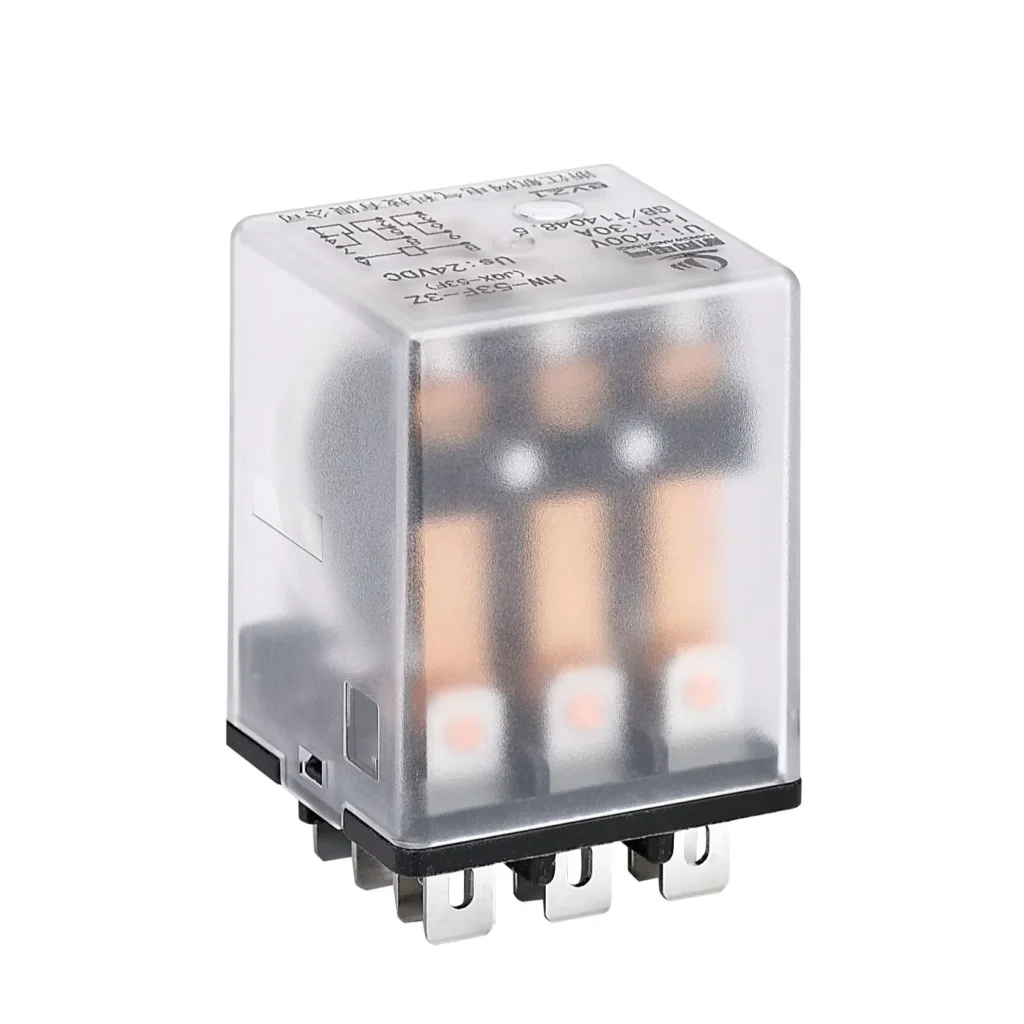
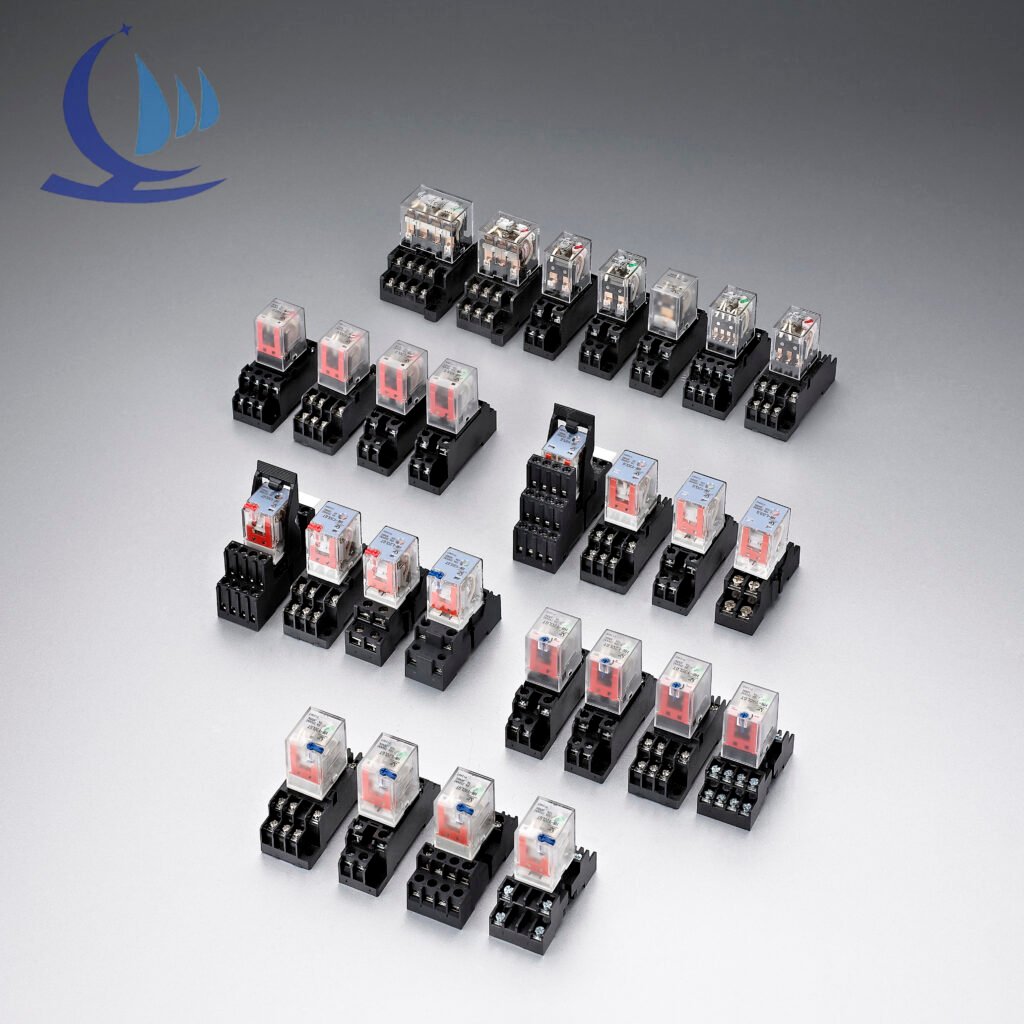
The HW-53F series sits in a useful zone for industrial purchasing because it combines multiple contact arrangements with a relatively compact body and broad coil-voltage coverage. The published product data lists dimensions of 38 × 36 × 56.5 mm, silver contacts, contact forms including 3Z, 3H, 3D, 2Z, 2H, and 2D, and resistive contact capacity up to 25A at 28VDC or 25A at 240VAC. The supplied product image also shows that the coding system supports plug-in, flange-mounted, and PCB-mounted structures, plus options such as LED indication, self-locking, mechanical indication, and diode/CR suppression.
Item
What it means for a buyer
Model family
HW-53F power relay series.
Contact options
3Z, 3H, 3D, 2Z, 2H, 2D, which gives flexibility for transfer, normally open, or normally closed logic.
Rated resistive load
25A/28VDC and 25A/240VAC.
Coil range
AC 6 to 380 V, DC 6 to 220 V.
Coil power
AC 2.5 VA, DC 1.8 W.
Mounting choices
Plug-in by default, F for flange mount, P for PCB mount.
Optional functions
L for LED, T for self-locking, G for mechanical indicator, D for diode/CR protection.
From a B2B angle, this is why the series is attractive for panel builders, OEM equipment makers, and maintenance buyers. You are not locked into one control voltage, one contact style, or one mounting format. That reduces the number of relay families you need to qualify internally, which makes procurement people calmer, engineers happier, and warehouse shelves less dramatic.
I would also not ignore the application fit. Industrial relay demand continues to track automation systems, motor control, heating control, power systems, and safety circuits, while overcurrent and power relays are commonly used to protect transformers, motors, feeders, and industrial machinery. So when a customer asks for a “25A power relay for industrial panel” or a “3 pole power relay for PLC output expansion,” they are not asking for an exotic niche part. They are asking for something that fits a very normal industrial problem.
Choosing the right HW-53F version
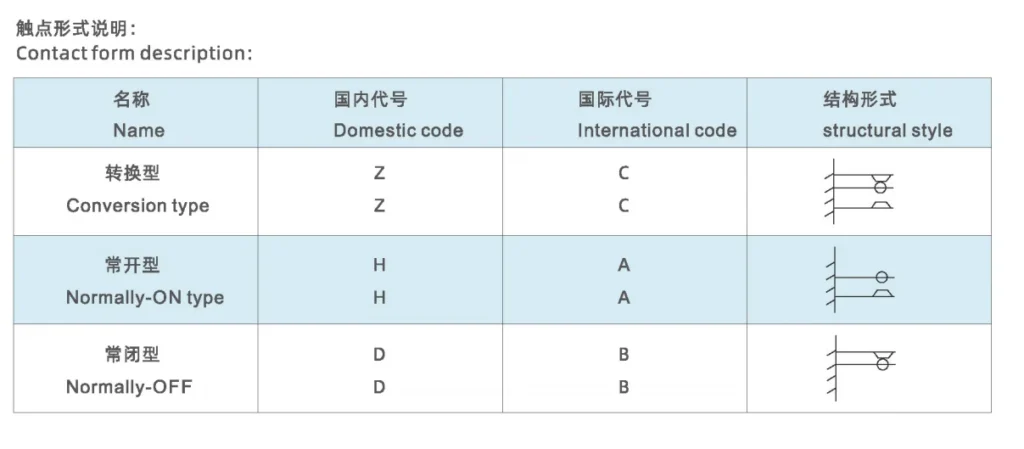
Now we get to the part buyers actually care about: not “Is the relay good?” but “Which version should I buy?” The coding printed in the supplied image is useful because it turns model selection into a logic exercise instead of a guessing game. In that coding, “3” means three contact groups, “Z” means conversion type, “H” means normally open, and “D” means normally closed. “F” means flange mounted, “P” means PCB mounted, and no extra mounting letter indicates plug-in style.
Buying situation
Recommended version logic
Why it fits
Panel wiring with easy replacement
HW-53F3Z plug-in
Plug-in structure simplifies maintenance and spares handling.
Mechanical indication gives visible status feedback.
Here is how I usually frame the selection for purchasing teams. If the load is a heater, resistive bank, or another clean resistive circuit, the published 25A resistive rating gives you a direct reference point. If the load is a motor, solenoid, transformer, or switching power supply, I become more conservative because inrush current changes the whole conversation. Omron’s high-capacity relay note points out that mechanical relays are widely used to switch power supplies and safely energize high voltages and large currents, which is exactly why inrush has to be considered early rather than after a contact welds shut.
That means “which relay should I choose” really comes down to the load profile:
If you are switching a resistive load near but below 25A, a standard HW-53F 25A power relay selection can be reasonable.
If you are switching motors or magnetizing loads, I would derate aggressively and verify inrush, duty cycle, and contact life before releasing a PO.
If your control side is 24VDC, a “24VDC high current relay” version is often the easiest fit for PLC and industrial control cabinets because 24VDC is standard in many automation systems.
If the maintenance team wants fast swap-out, plug-in beats PCB almost every time.
If the end customer asks for visible status, order the LED version from day one. Retrofits are where budgets go to cry.
For OEMs and distributors, that also opens a useful sales angle: you can quote the same base family as a “high current relay supplier” solution across several end uses, then customize by contact form, mounting style, and coil voltage without redesigning the whole BOM.
Wiring that makes sense on site
The product page confirms broad coil-voltage options and multiple contact forms, but the smartest wiring decision is still application-led. The HW-53F series supports AC coils from 6 to 380 V and DC coils from 6 to 220 V, with pickup voltage of DC ≤75%≤75% and AC ≤80%≤80%, plus dropout voltage of DC ≥10%≥10% and AC ≥30%≥30%. Those numbers matter because stable relay operation starts with giving the coil the voltage it expects, not the voltage we wish the cabinet happened to have.
Wiring scenario
Practical connection approach
Product fit
PLC output controls a larger load
Use PLC output to energize the relay coil, then switch the load through the relay contacts
Broad DC and AC coil-voltage options help match control circuits.
Two circuits need changeover logic
Use 2Z or 3Z contact form for transfer switching
2Z and 3Z are listed contact forms in the series.
Only make-contact action is needed
Use 2H or 3H
H is normally open in the coding.
Only break-contact action is needed
Use 2D or 3D
D is normally closed in the coding.
Frequent replacement expected
Choose plug-in mounting and socket-based layout
Plug-in style is part of the product coding scheme.
Cabinet needs clear status indication
Use LED version and mechanical indicator when required
L and G options are available in the coding.
In practice, I wire this kind of High Current Relay in a very boring way, and that is a compliment. The coil side belongs to the control circuit. The contact side belongs to the power or load circuit. Keep those functions mentally separate, and most wiring mistakes disappear before they are born. If the control system is a PLC, I use the PLC output only to drive the coil and let the relay contacts handle the field load. That is the classic “high current relay for PLC control” use case, and it saves fragile controller outputs from doing heroic things they were never hired to do.
For contact selection, I keep it simple. A 3Z version is useful when one High Current Relay must switch multiple circuits or provide changeover logic. A 3H version makes sense when you want three normally open paths, and a 3D version suits circuits that need a normally closed state until the coil is energized. If the cabinet uses DC coils, adding the diode/CR protection option is a sensible way to improve suppression strategy on the coil side.
I also tell customers one thing that prevents many field issues: do not choose a relay only by steady-state current. If the load has inrush, measure it or get the real value from the equipment maker. A 10A load with ugly inrush can be harder on contacts than a polite 20A resistive heater. High Current Relay are honest devices, but they are not magicians.
What B2B buyers should check before ordering
For industrial purchasing, the relay itself is only half the decision. The other half is whether the chosen version matches installation method, replacement practice, inventory strategy, and field-service expectations. The HW-53F data lists dielectric strength of 1500 VAC between open contacts, 1500 VAC between contact pieces, and 2500 VAC between coil and contacts, with insulation resistance of at least 100 MΩ at 500 VDC. The same data lists electrical life at 5×1045×104 operations, mechanical life at 5×1055×105, and ambient temperature from -25°C to +55°C.
Procurement checkpoint
Why it matters
HW-53F data point
Insulation and isolation
Supports safety margin inside industrial panels
1500 VAC and 2500 VAC dielectric values are listed.
Temperature range
Confirms cabinet-environment suitability
-25°C to +55°C.
Electrical life
Helps estimate maintenance interval
5×1045×104 operations.
Mechanical life
Indicates basic switching endurance
5×1055×105 operations.
Physical size
Affects layout and spacing
38 × 36 × 56.5 mm.
Weight
Matters for packaging and some mounting designs
2C: 77 g, 3C: 81 g.
Someone searching “industrial power relay manufacturer,” “high current relay supplier for OEM,” or “bulk order 25A relay” usually wants more than a low unit price. They want consistency in coil options, stable delivery, clear coding, and enough product variants to avoid redesign. The HW-53F family structure supports that conversation because the coding system itself communicates mounting, contact logic, indication, and protection choices.
From my side of the desk, I would ask a buyer these questions before I quote anything:
Is the load resistive, inductive, capacitive, or mixed?
What is the real control voltage at the coil?
Do you want plug-in maintenance or fixed mounting?
Is visible status indication required?
Is this for a one-off machine, annual blanket demand, or distributor stock?
Those questions sound basic, but they are where good projects stop being expensive surprises. And yes, they are also where serious buyers separate from the “send me your best price” email that arrives with no voltage, no load type, and no shame. If your project needs a quotation, sample, or OEM matching recommendation, this is exactly the stage where sending an inquiry makes sense.
FAQ
Is HW-53F3Z a true high current relay option for industrial loads?
Yes, the published resistive rating reaches 25A at 28VDC and 25A at 240VAC.
Which version is better for panel builders: plug-in, flange, or PCB?
The series includes DC coil voltages from 6 to 220 V, so 24VDC falls within the listed range.
Is it suitable for motors and power supplies?
It can be used in industrial applications, but inductive or inrush-heavy loads should be derated and checked carefully.
What matters most for bulk purchasing?
Coil voltage, contact form, mounting style, and field-replacement method matter more than unit price alone.
Can this relay work as a 3 pole power relay for control cabinets?
Yes. The coding in the supplied image shows three-contact-group versions, and the product page lists 3Z, 3H, and 3D among the available forms. For cabinet builders, that is useful when one relay needs to switch multiple signal or load paths at once.
What is the safest way to choose between 2Z and 3Z?
I choose 2Z when the control logic is simpler and cabinet space matters more than extra switching flexibility. I choose 3Z when the machine needs more changeover paths, interlock logic, or future-proofing. The important part is not to buy extra poles “just in case” unless the panel design really benefits from them; unnecessary complexity has a sneaky talent for becoming tomorrow’s service call.
Is this a good relay for OEM and distributor programs?
It can be, because the family covers multiple mounting types, multiple contact structures, broad coil voltages, and optional LED or protection functions in one naming system. That makes it easier to standardize a platform while still offering variants to different customers.
What should I confirm before placing a bulk order?
Confirm the exact coil voltage, contact form, mounting structure, and whether the project requires LED indication, mechanical indication, or suppression. The coding shown in the supplied image makes those options explicit, which is a good sign for purchasing clarity. I would also confirm whether the load is resistive or has inrush, because that affects relay selection more than many buyers expect.
Does a high current relay eliminate the need for contactors?
Not always. A high current relay is excellent in many control and switching jobs, but once the load becomes very large, very inductive, or very frequent in operation, the right device may still be a contactor or another dedicated switching solution. The honest answer is that good engineers do not marry one component category; they choose the one that best survives the application.
Miniature Relay are essential components in industrial automation. With their compact size, stable performance, and flexible installation, miniature relay are the preferred choice for modern automation system design. But with so many relay options on the market, how can you select the best one for your needs? In this article, we’ll guide you through the […]
In modern industrial automation systems, industrial relay contact serve as essential bridges for electrical control. At the heart of every relay are its contacts-the components responsible for making or breaking the circuit. The performance and reliability of these contacts directly impact the stability and safety of the entire system. Many relay failures can be traced […]
Schneider Electric Company type: Multinational electrical and automation company Basic information: Schneider Electric is a global leading provider of energy management and automation solutions headquartered in France and founded in 1836. The company focuses on providing efficient electrical equipment, automated control systems and energy management solutions, and is committed to promoting sustainable development and digital […]
We use cookies to enhance your browsing experience, serve personalised ads or content, and analyse our traffic. By clicking "Accept All", you consent to our use of cookies.
Get a Free Quote
Your email information is completely secure and will not be disclosed to third parties for any reason.
Interested In Our Relay Products?
Get the latest product brochures and technical data.